





Cardo Packtalk Edge Review: Real-World Performance After 12 Months
After 12 months on the bike with the Cardo PACKTALK EDGE, here is the short answer: it is the right intercom for riders who want full DMC mesh, premium audio, and all-day battery without paying for Crash Detection.
The 13-hour battery holds up, the 40mm JBL speakers cut through wind noise on the motorway, and the Air Mount makes moving between helmets effortless. If you ride in a group, tour long distances, or want the most reliable mesh on the market, the PACKTALK EDGE delivers.
I will cover what I have learned across daily commutes, weekend group rides, two multi-day tours, and one very wet winter. If you are still narrowing down options, the how to choose a motorcycle intercom guide is worth a read first.
One Year of Riding With the PACKTALK EDGE
Twelve months in, the PACKTALK EDGE has logged commute miles, group ride miles, two multi-day tours, and a long winter of cold-weather riding. It has been through rain, road spray, washes, and the occasional drop while moving between helmets. The unit still mounts the same way it did on day one, the speakers still sound the same, and the battery still hits the rated 13 hours in moderate conditions.
That alone tells you most of what you need to know. The interesting questions are how it performs in the edge cases: cold weather battery, voice control at motorway speed, group reconnection after splits, and durability across a year of British weather. Which is what the rest of this review covers.
Setup, Install, and First Impressions
What's in the Box and How Long Setup Takes
The box arrives with the main unit, the Air Mount cradle and adhesive base plate, two 40mm JBL speakers with Velcro pads, a wired microphone for full-face helmets, a boom microphone for modular and open-face helmets, a USB-C cable, and a quick start guide. First-time install on a standard full-face helmet took me about 25 minutes start to finish.
For a full step-by-step walkthrough across helmet types, see the installation guide. The two things that matter most: clean the helmet ear cavities properly before sticking the speaker pads, and give the Air Mount adhesive a full 2 hours to cure before clicking the unit on.
The Air Mount: Fitting
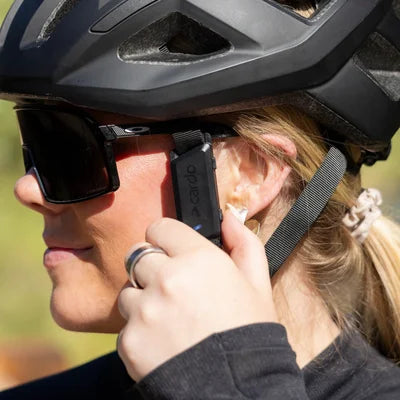
The Air Mount is the feature I appreciate most a year in. The magnetic snap-on means I can move the unit between two helmets in seconds without tools or fiddling with clips. The magnetic hold is strong enough that I have never had the unit shift in 12 months of riding, including on rough roads and one accidental tip-over in a car park.
If you have a helmet with a thick or curved rim where the standard adhesive will not sit flat, the glue plate method works as a fallback, but allow 24 hours to cure properly.
First Pairing via Cardo Connect App
Download the Cardo Connect App, hold the main button to power the unit on, and pair from your phone's Bluetooth settings. The app then walks through audio profile setup, intercom preferences, and a check for firmware updates. I ran the firmware update before my first ride and it took about five minutes over Wi-Fi.
Audio Quality at Real Riding Speeds
The JBL 40mm Speakers: What They Sound Like on the Move
The 40mm JBL speakers are noticeably better than anything I have run before. Music has actual low end, podcasts are clear without cranking the volume, and intercom voices sound like the person is in the helmet with you rather than on a phone call. At 30 to 50 mph the audio is excellent. At motorway speeds, the wind starts to compete, but the speakers hold their own up to about 80 mph before I have to nudge the volume.
One thing worth mentioning: speaker placement makes a big difference to how they sound. A lot of riders position these wrong, sitting off-centre from the ear, and then complain the audio is poor. Get them lined up directly over your ears, and the difference is significant, so it is worth taking a minute during install to get it right.
Compared with the 45mm speakers on the PACKTALK PRO, the difference is real but not dramatic. For the majority of riders, 40mm versus 45mm JBL is noticeable but not decisive. If you ride primarily on motorways at high speed and audio is your top priority, the PACKTALK PRO's larger speakers are worth considering. For everyone else, the PACKTALK EDGE's 40mm units are more than enough.
Changes: added a short paragraph on placement (mispositioning is a common cause of complaints), and swapped one of the two "decisive" instances so it now reads "real but not dramatic" then "noticeable but not decisive."
Auto Volume and Wind Noise Handling
Auto volume adjustment via the Cardo Connect App handles the speed-to-noise relationship well. As speed increases, the volume scales with it. I had to tune the sensitivity once in the app to suit my helmet, and after that, it has been hands-off for a year. Wind noise above 70 mph is the main limit, but it is a helmet aerodynamics issue more than a Cardo issue: a quieter helmet shell means clearer audio at speed.
Call Quality and Intercom Audio via DMC
Phone call quality is the area where the PACKTALK EDGE has surprised me most. The wideband audio over DMC and Bluetooth 5.2 is clearer than the phone speaker would deliver on its own. People on the other end of calls have remarked that I sound like I am in a quiet room, even at 60 mph. Intercom audio between Cardo units on DMC is even better, since the wideband codec runs directly between units without going through cellular compression.
Battery Life: Testing the 13-Hour Claim
All-Day Touring: How the Battery Holds Up
Cardo rates the PACKTALK EDGE at 13 hours of talk time, and that is what I get in moderate conditions with a mix of music, intercom, and GPS audio. On a typical 8-hour touring day, I finish with the battery at around 35%. On a long 11-hour day with full intercom in a group ride, I finish closer to 10% but still have margin to make it home. The 13-hour figure is realistic, not optimistic.
Fast Charge: 20 Minutes for 2 Hours of Use
Fast charging is the underrated feature. 20 minutes of charging delivers 2 hours of talk time, which means a lunch stop on a touring day effectively resets the battery anxiety question. Combined with USB-C charge-while-riding from a power bank or your bike's USB port, there is no realistic touring scenario where the PACKTALK EDGE runs out before you do.
Cold Weather and Battery Drain
Cold weather is where any lithium battery loses capacity, and the PACKTALK EDGE is no exception. On a 5°C winter day with continuous intercom, music, and GPS, I get closer to 10 to 11 hours rather than the rated 13. That is still enough for almost any single-day ride. Storing the helmet indoors overnight and charging the unit fully the night before makes a noticeable difference.
Group Riding With 2nd Generation DMC: Small Crew to Full Mesh
Setting Up a Private Group and Open Mesh
Setting up a DMC private group is the single most impressive part of the PACKTALK EDGE for group riders. Pairing a group of 10 took us about 30 seconds at the start of a recent ride. After the initial setup, every subsequent ride with the same group just works: power the units on, they find each other, and the network is up. Open mesh lets any Cardo DMC unit join without pre-pairing, which is useful for ad-hoc group rides or meeting riders for the first time at the petrol station.
Range in Practice: Tight Roads and Open Motorways
Cardo quotes up to 1.6km unit-to-unit and up to 8km across the full group network. On an open motorway with a line of sight between riders, I have hit the unit-to-unit range comfortably. On twisty B-roads with tree cover and dips, the range is shorter, which is expected. Real-world range varies based on terrain and obstacles. What matters is that the mesh routes the signal through every rider in the group, so the effective range across a 10-rider group spread across several miles of road is still solid.
Auto-Reconnect After Splits and Fuel Stops
The self-healing mesh is the single feature that justifies DMC over Bluetooth in my view. If a rider stops for fuel, takes a wrong turn, or falls back at traffic lights, the rest of the group stays connected, and the separated rider rejoins the network automatically when back in range. No re-pairing, no manual reconnection, no rider lost from the group. After 12 months, this has worked every time without my needing to think about it.
Natural Voice Operation: How Reliable Is It?
'Hey Cardo' Commands at Speed
Natural Voice Operation is reliable for the commands I use most: answering a call, ending a call, starting an intercom, skipping a track, and adjusting volume. "Hey Cardo, answer" works at the first try about 95% of the time in moderate conditions. The microphone is sensitive enough to pick up commands above engine noise, but it benefits from a microphone position close to the corner of your mouth, which the install guide covers properly.
When NVO Works Well and When It Doesn't
NVO is less consistent in two situations: tight full-face helmets with thick cheek padding that muffle the microphone, and sustained riding above 70 mph where road noise interferes with command recognition. For complex multi-step commands, I still tend to use the button or the app. For simple commands like "answer call" or "next track," voice operation is the faster, safer option.
Durability: IP67 After 12 Months and Heavy Use
Rain, Washing, and Submersion Risk
IP67 means full dust protection plus resistance to water submersion up to 1 metre for 30 minutes. In a year of riding, I have ridden through heavy rain on multiple occasions, washed the helmet with the unit attached, and had the unit covered in road spray on motorway sections. Zero water ingress, zero audio drop-outs, zero issues. The one caveat: avoid directing high-pressure water jets straight at the unit when cleaning.
Unit and Cradle Wear After Extended Use
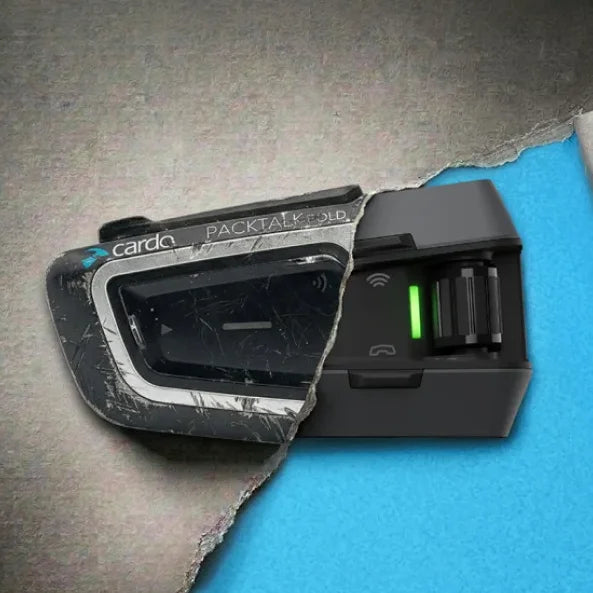
Twelve months in, the unit itself shows minor cosmetic wear on the corners where it has occasionally bumped against helmet edges during installation. The Air Mount cradle still holds the unit as securely as on day one. The USB-C port has had no fit issues despite being plugged in 100+ times. The speakers and microphone have not degraded in audio quality. For a unit that lives outdoors on a helmet, the build quality has held up well.
Navigation and Phone Integration on Long Rides
Cardo Ride App and GPS Voice Directions
For ride tracking and route planning, I use the Cardo Ride app (formerly RISER). It handles motorcycle-specific routing, route sharing with riding buddies, and the reWind ride recap feature that gives you a 3D map highlight after each ride. GPS voice directions come through the helmet audio without conflicting with intercom or music, which the PACKTALK EDGE mixes intelligently in the background.
Phone Calls Hands-Free: NVO in Traffic
Hands-free phone calls work reliably in traffic, which is the test that matters. Stop-start city riding is where voice operation earns its keep: I have never needed to take a hand off the bars or pull over to take a call in 12 months. The same goes for music control, which means I can manage playback at traffic lights without reaching for the phone.
PACKTALK EDGE vs PACKTALK PRO: Should You Pay the Extra $60?
The PACKTALK PRO is the only Cardo unit above the PACKTALK EDGE in the current range. It sits $60 above the PACKTALK EDGE at $499.95 vs $439.95. The question is whether the upgrade is worth it for your riding.
What the PACKTALK EDGE Gives Up vs the PACKTALK PRO
The PACKTALK PRO adds three things the PACKTALK EDGE does not have:
- Crash Detection: The three-part system that uses unit sensors, the Cardo Connect App, and Cardo's cloud to detect impacts and send an automated emergency alert with GPS location to a designated contact.
- 45mm JBL speakers: Up from 40mm on the PACKTALK EDGE.
- Auto On/Off via an IMU-powered proximity sensor: Crash Detection is region-restricted and available in selected countries only.
|
Feature |
PACKTALK EDGE |
PACKTALK PRO |
|---|---|---|
|
Price |
$439.95 |
$499.95 |
|
Crash Detection |
No |
Yes (selected regions) |
|
JBL speakers |
40mm |
45mm |
|
Auto On/Off |
No |
Yes |
|
DMC mesh |
2nd Generation, up to 31 riders |
2nd Generation, up to 31 riders |
|
Battery |
13 hours |
13 hours |
|
Waterproofing |
IP67 |
IP67 |
|
Air Mount |
Yes |
Yes |
|
Charge while riding |
Yes (USB-C) |
Yes (USB-C) |
|
Warranty |
3 years |
3 years |
What the PACKTALK EDGE Retains and Why It Matters
Both units share the things that matter most for everyday riding: 2nd Generation DMC with 15-rider capacity, IP67, Air Mount, 13-hour battery, fast charge, USB-C, Bluetooth 5.2, and the 3-year warranty. If you are buying primarily for group communication, both models deliver the same mesh performance.
The PACKTALK EDGE holds the full premium mesh experience at $60 less than the PACKTALK PRO. For a fuller spec-by-spec breakdown, see the dedicated EDGE vs PRO comparison or use the product comparison tool.
Who Should Choose the PACKTALK PRO Instead
Choose the PACKTALK PRO if any of three things apply: you ride solo in remote areas where Crash Detection would meaningfully change your safety profile (and you are in a region where Crash Detection is available), you ride mostly on high-speed motorways where the larger 45mm speakers will deliver noticeably clearer audio, or you want the convenience of Auto On/Off so the unit powers up the moment the helmet comes off the shelf. For most riders, the PACKTALK EDGE is enough.
Verdict: Who Is the PACKTALK EDGE For?
After 12 months, my verdict is straightforward.
For Group Riders and Club Members
The PACKTALK EDGE is the unit to buy. Full 2nd Generation DMC mesh, up to 31 riders, self-healing reconnection, and the same group range as the PACKTALK PRO. Crash Detection is not necessary in a group where other riders can call for help.
For Tourers Who Ride Mostly in Pairs
The PACKTALK EDGE gives you the full premium audio and battery experience without paying for Crash Detection that a touring partner partially substitutes for. The 13-hour battery, fast charge, and charge-while-riding cover any touring day.
For Solo Riders in Remote Areas
Consider the PACKTALK PRO instead. The Crash Detection emergency alert is the feature that justifies the upgrade if you ride alone in places where help is not immediately available, provided Crash Detection is available in your region.
For Budget-Conscious Riders or Small Groups of Up to 4
Look at the FREECOM 4X. It uses standard Bluetooth rather than DMC, so the group sits in a chain rather than a self-healing mesh, but for small groups riding close together, it is more than enough at a lower price.
Shop the PACKTALK EDGE or browse the full range of Cardo motorcycle intercoms.
PACKTALK EDGE REVIEW: FAQs
Is the Cardo PACKTALK EDGE worth buying?
Yes. The PACKTALK EDGE is the strongest premium group-riding and touring intercom at its price. The 13-hour battery, 2nd Generation DMC mesh for up to 31 riders, IP67 waterproofing, and 40mm JBL speakers deliver everything most riders need. If you specifically want Crash Detection, choose the PACKTALK PRO instead. For everyone else, the PACKTALK EDGE is the better-value flagship.
How long does the PACKTALK EDGE battery last in real use?
13 hours of talk time in moderate conditions, closer to 10 to 11 hours in cold weather with continuous intercom, music, and GPS audio running together. Fast charge recovers 2 hours of use in 20 minutes, and charge-while-riding over USB-C means full-day touring is realistic without battery anxiety.
Does the Cardo PACKTALK EDGE have crash detection?
No. Crash Detection is exclusive to the PACKTALK PRO. The PACKTALK PRO uses unit sensors, the Cardo Connect App, and Cardo's cloud to detect significant impacts and send an automated emergency alert with the rider's GPS location to a designated contact. Crash Detection is available in selected regions only. Riders who need this feature should choose the PACKTALK PRO.
How many riders can connect to the PACKTALK EDGE?
Up to 31 riders via 2nd Generation DMC mesh. Group range extends to 8km / 5 miles across the network as the signal relays through each rider. Open mesh allows any compatible Cardo DMC unit to join without pre-pairing; private group restricts access to invited riders only. Real-world range varies based on terrain and obstacles.
Can the PACKTALK EDGE connect to Sena intercoms?
Yes, via standard Bluetooth pairing. Native DMC mesh works only between Cardo units. Cross-brand Bluetooth pairing works for basic intercom but limits the group to a Bluetooth chain rather than a self-healing mesh, with smaller group capacity and shorter effective range in mixed-brand setups.
Is the PACKTALK EDGE truly waterproof?
Yes. IP67 rated means fully dust-tight and submersion-tested to 1 metre for 30 minutes. The PACKTALK EDGE handles heavy rain and sustained road spray without issue in real-world riding. Avoid directing pressurised water jets directly at the unit when washing your helmet.
What is the difference between the PACKTALK EDGE and PACKTALK PRO?
The PACKTALK PRO adds Crash Detection, 45mm JBL speakers (vs 40mm on the PACKTALK EDGE), and Auto On/Off. Both share 2nd Generation DMC with 15-rider capacity, IP67, Air Mount, 13-hour battery, fast charge, charge-while-riding, and a 3-year warranty. The price difference is $60 at $499.95 for the PACKTALK PRO versus $439.95 for the PACKTALK EDGE.
How reliable is Natural Voice Operation on the PACKTALK EDGE?
Reliable for call and music control in most helmet types. Less consistent in tight full-face helmets with thick cheek padding, and road noise above 70mph can occasionally interfere with command recognition. Best used for simple commands like call answer and track skip rather than complex multi-step inputs.
Does the PACKTALK EDGE support charge while riding?
Yes. The PACKTALK EDGE supports charge-while-riding via USB-C cable from a power bank or your bike's USB port, making full-day touring possible without battery anxiety. Combined with the 20-minute fast charge that delivers 2 hours of talk time, you can top up at fuel stops and ride continuously.
Which Cardo intercom is best for a group of 6 or more riders?
Both the PACKTALK EDGE and PACKTALK PRO support 15-rider DMC 2.0 mesh with self-healing reconnection and up to 8km group range. For groups where individual Crash Detection matters and Crash Detection is available in your region, the PACKTALK PRO is the stronger choice. For groups focused purely on communication, the PACKTALK EDGE delivers the same mesh performance at $60 less.