




Ski helmet speakers come in four forms: drop-in audio chips that slide into your helmet’s ear pads, helmets with audio built in at the factory, helmet intercoms that connect a whole group across the mountain, and ordinary earbuds or headphones worn under the shell. The first three all play music and take calls. Only an intercom, or a helmet with an intercom inside it, lets you talk to your group hands-free without leaning on your phone’s cell signal.
This guide explains how each type fits your helmet, what it does well, and where it falls short. If you ski on your own and want a soundtrack for the day, a pair of chips will cover you. If you ski with family, a crew of friends or a group of students, the choice comes down to something else: how your group stays in touch once everyone spreads out across different runs.
|
Type |
How it fits |
Music and calls |
Talk to your group |
Needs cell signal for group talk |
|---|---|---|---|---|
|
Drop-in audio chips |
Slide into audio-ready ear pad pockets |
Yes, paired to your phone |
Some models, through an app with push-to-talk |
Yes, app features run on phone data |
|
Built-in audio helmets |
Speakers and mic integrated into the helmet |
Yes |
Depends on the model |
No, on models with built-in mesh |
|
Helmet intercoms (such as Packtalk Outdoor) |
Unit mounts to the helmet, speakers sit in the ear pockets |
Yes |
Yes, always-on and hands-free |
No |
|
Earbuds or over-ear headphones |
In or over the ear, under the shell |
Yes |
Phone calls only |
Yes, for calls |
What Are Ski Helmet Speakers?
Ski helmet speakers are thin, flat speakers, usually around 40mm across, that sit inside the ear pads of your helmet instead of inside your ear. Most ski and snowboard helmets sold as audio-ready or audio-compatible have a pocket behind each ear pad, sometimes zippered, sized for this kind of speaker. You drop the speaker in, connect it over Bluetooth or a short cable, and the ear pad holds it a few millimeters off your ear.
That small gap does a lot of work. With the speaker resting beside your ear rather than sealing it, you still hear a snowboarder carving up behind you, a lift attendant calling you forward, or a patroller shouting a warning at a merge. Earbuds plug the ear canal and strip most of that out. Over-ear headphones rarely fit under a ski helmet at all without pressing hard into the sides of your head.
The Four Types of Ski Helmet Audio

Drop-In Audio Chips
Best for: solo skiers who want music and calls without changing helmets.
Audio chips are self-contained Bluetooth speaker pairs, sold by brands such as Outdoor Tech and Aleck, that pair with your phone and slot into your helmet’s ear pockets. One chip carries the battery and a pair of buttons big enough to press through a glove, and a small microphone picks up your voice for calls and voice assistant commands.
Chips let you keep the helmet you already own, which matters if you spent an afternoon in a shop getting the fit right. For music and the occasional call, they do the job at a modest price. Group talk is where you hit their limit. Some chip sets add a push-to-talk walkie-talkie feature through a companion app, and that app sends your voice over your phone’s cell connection. On a front-side groomer with strong coverage, the feature works. In a tree run, a back bowl or a valley where your phone drops to one bar, messages lag or fail, and you have to hold a button down for every sentence you say.
Helmets With Built-In Audio
Best for: skiers buying a new helmet who want audio and helmet in one purchase.
Communication helmets ship with speakers, a microphone and controls already built into the shell and ear pads. Sena’s Latitude S2 is one example: Sena builds its Mesh Intercom and 40mm speakers into the ear pads and puts large buttons on both sides so you can work them with gloves on. You unbox it, charge it and ski, with nothing to install.
The trade-off is that your audio system and your helmet now share a lifespan. You should replace a ski helmet after a hard impact, and when you do, the electronics go in the bin with it. You also tie your audio to whichever shells that brand makes. If a different helmet fits your head better, you have to give up the integrated audio to wear it.
Ski Helmet Intercoms
Best for: families, friends who ski together, instructors, and any group that wants to talk without touching a phone.
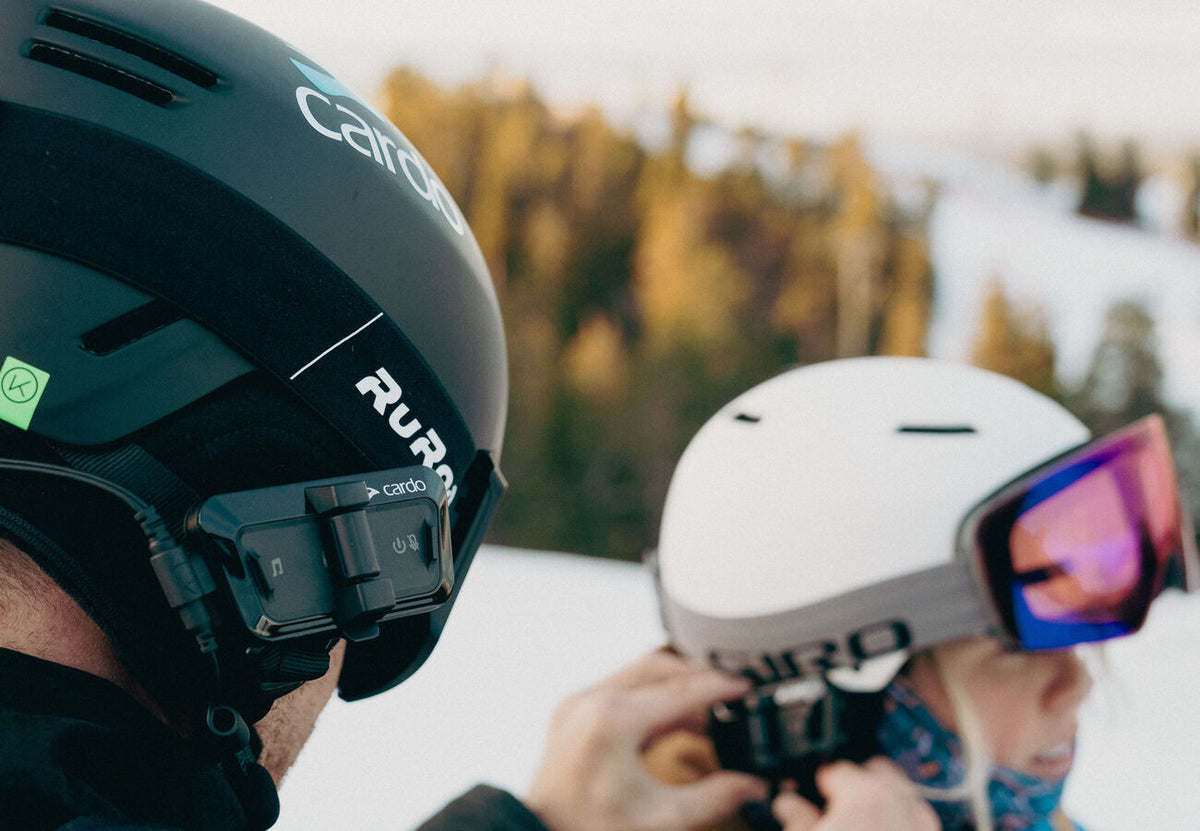
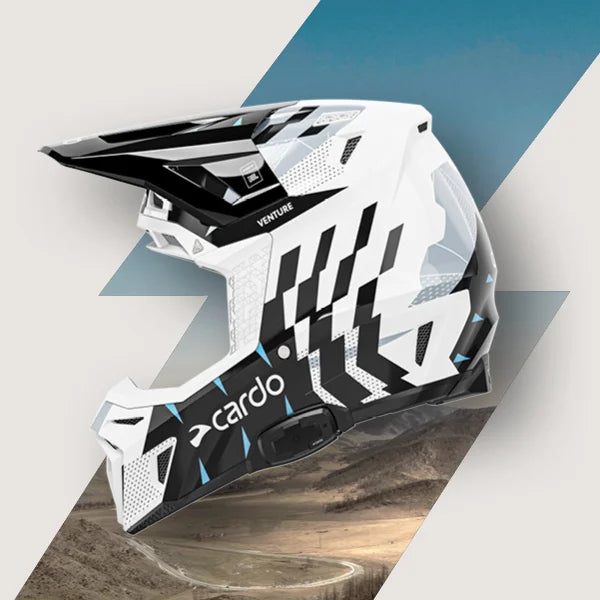
A helmet intercom is a compact unit that mounts to your helmet and drives a pair of in-helmet speakers and a microphone. It streams music and takes calls the way chips do. The difference is that it also links you directly to every other skier in your group, unit to unit, with no phone network in between. Cardo’s Packtalk Outdoor works this way: the unit sits on the outside of your helmet, the JBL speakers drop into the ear pockets, and the intercom stays open all day, so you talk to your group the way you would if you were standing next to them in the lift line.
Intercoms connect a group in one of two ways. A Bluetooth intercom pairs riders in a chain, with each person linked to the next. A mesh intercom, such as Cardo’s Dynamic Mesh Communication (DMC), builds a network where any unit can relay the signal, and if one skier drops out of range, everyone else stays connected. You feel the difference on a mountain, where a group of four can end up split between a chairlift, a run and the lodge inside ten minutes. If you want the technical detail, Cardo breaks it down in its guide to mesh vs Bluetooth communication.
Earbuds and Over-Ear Headphones
Best for: a one-off test day before you commit to a helmet audio setup.
You can push earbuds in, pull your helmet on over them and head for the lift, and plenty of people do on their first trip. The helmet presses the buds deeper into your ear canal, which starts to ache after a few runs and can hurt if you fall on that side. Sealed buds and noise-cancelling modes also block the sounds you need on a busy slope. Over-ear headphones tend to lift the helmet off your head or squash the ear pads, which loosens the fit your helmet depends on to protect you.
Cold makes things worse. Small earbud batteries drain fast below freezing, and touch controls rarely register through a glove, so you end up pulling a glove off on the chair every time you want to skip a song.
How Group Talk Works on Each Type

Every type on this list plays music. Where ski helmet audio systems split is in how you talk to the people you ski with, and you have three options.
With app-based push-to-talk, your phone does the work. You hold a button, speak, and the app sends the clip over cell data to your friends’ phones and on to their helmets. Each person in the group needs signal, the app running and a free hand or a glove-friendly button for every message.
A Bluetooth intercom skips the phone network and pairs the helmet units to each other directly. Conversations stay open, so nobody presses anything to speak. Range shrinks as the chain gets longer, and if the skier in the middle of the chain falls behind, the riders on either side of them lose each other.
Mesh connects each unit to every other unit it can reach. Packtalk Outdoor runs Cardo’s 2nd Generation DMC, which links up to 31 riders, with a range of up to 1km (0.6mi) between two skiers and up to 5km (3mi) across the whole group. Cardo rates those figures for mountain terrain, where ridgelines, trees and lift towers sit between you and your friends, and real-world range varies with terrain and obstacles. When a skier goes out of range and comes back, their unit rejoins the group on its own, and nobody has to re-pair anything at the top of the next lift.
What to Check Before You Buy Ski Helmet Headphones

Awareness on the Slope
Choose speakers that sit in the ear pad, not in your ear. Set the volume low enough that you can still hear someone talking a few meters away, and turn it down further in lift lines, on crowded beginner runs and anywhere two trails merge. An open intercom gives you an extra layer of awareness: a friend behind you can call out a skier coming fast on your left before you would ever see them.
Controls You Can Use With Gloves On
Thick gloves and mittens make small touch surfaces useless. Look for large physical buttons or voice control. Packtalk Outdoor uses Natural Voice Operation, so you say “Hey Cardo” followed by a command to change the volume, skip a track or answer a call while both hands stay on your poles.
Snow, Moisture and Cold
Snow melts against a warm helmet and goggles shed moisture, so damp ear pads are part of every ski day. Check the water resistance rating on anything you mount to the outside of the helmet. The Packtalk Outdoor unit carries an IP67 rating, which means it is dust-tight and can survive immersion in water. That rating covers the unit itself and not the speakers, so keep the ear pockets closed while you ski and let the pads dry out overnight.
Battery Life in the Cold
Lithium batteries lose capacity in low temperatures, so a battery figure measured at room temperature can overstate what you get on a January chairlift. Look for a rating the manufacturer measured in cold conditions. Cardo rates Packtalk Outdoor at up to 10 hours in the cold, and 20 minutes on a USB-C charger over lunch gives you two more hours of talk time. Keep your phone in an inside pocket as well, since your phone powers your music and calls.
Helmet Fit and Installation
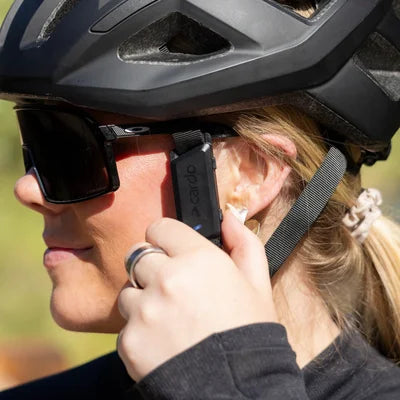
Confirm your helmet has audio-ready ear pads before you buy chips or an intercom. Most current ski and snowboard helmets do, but pocket depth, zipper placement and cable routing differ from brand to brand. Cardo offers a strap mount and an adhesive plate for Packtalk Outdoor so you can fit the unit to different helmet shapes. Do a test fit at home: put the helmet on, check that nothing presses on your ears, and make sure the microphone sits close to your mouth before you ride your first chair.
Where Packtalk Outdoor Fits
Best for: groups of two or more who want to talk hands-free all day without depending on cell coverage.
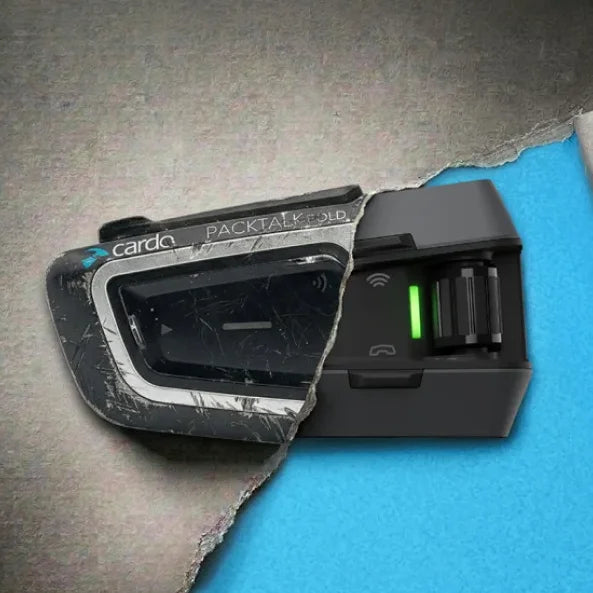
Packtalk Outdoor is Cardo’s helmet intercom for skiing and snowboarding. It plays music and takes calls from the phone in your pocket through 40mm JBL speakers, and it keeps your whole group on an always-on intercom with no internet or cellular connection required. The unit runs 2nd Generation DMC for up to 31 riders, carries an IP67 rating, lasts up to 10 hours in cold conditions, and takes Natural Voice Operation commands, so you rarely need to touch a button. You set it up and install over-the-air software updates through the Cardo Connect app, and Cardo covers it with a 2-year warranty.
A single unit costs $269.95, and Cardo sells Duo and Family 4-Pack options for groups. Ski instructors can also choose instructor and student kits from the Cardo outdoor collection. If you already know you want an intercom and want to compare ski communication options in more depth, read Cardo’s guide to the best communication system for skiing and snowboarding.
Which Type of Ski Helmet Audio Should You Choose?
Drop-in chips suit you if you ski alone most days, your helmet already has audio pockets, and music plus the odd phone call is all you want. You keep your helmet and spend the least.
A built-in audio helmet makes sense when you need a new helmet this season anyway and the brand’s shell fits your head well. You get a clean, wire-free setup, and you accept that the audio retires when the helmet does.
For a family keeping track of kids, friends who split up on different runs, or an instructor coaching a group, an intercom solves the problem the other types leave open. You talk the way you would face to face, with no buttons, no phone and no reliance on how many bars you have halfway up a bowl.
Earbuds under a helmet only work as a short-term stopgap. If you find yourself reaching for them every trip, move to speakers that sit in your ear pads.
Frequently Asked Questions
Can you wear headphones under a ski helmet?
You can, but earbuds and over-ear headphones are a poor fit under a ski helmet. The shell presses earbuds into your ear canal and pushes over-ear cups against your head, which gets painful and loosens the helmet’s fit. Speakers that sit inside audio-ready ear pads give you the same music without either problem.
Are ski helmet speakers safe to use on the slopes?
Ski helmet speakers are safer than earbuds because they sit next to your ear and let ambient sound through. Your volume decides most of the risk. Keep it low enough to hear people around you, and turn it down on crowded runs and at trail merges.
Do ski helmet speakers work without cell service?
Music and calls work through your phone’s Bluetooth connection, so calls need a cell signal and music needs downloaded tracks or a data connection. App-based walkie-talkie features also need cell data. A dedicated intercom such as Packtalk Outdoor links helmets directly, so group conversation keeps working with no cell coverage at all.
How can you talk to friends while skiing?
The most reliable way is a helmet intercom that keeps an open channel between every skier in your group. Packtalk Outdoor connects up to 31 riders over Cardo’s DMC mesh, so you speak at a normal pace without pressing a button or holding your phone. Push-to-talk apps and handheld radios also work, but both need a free hand and, for apps, a cell signal.
Can I use a motorcycle intercom for skiing?
Cardo built Packtalk Outdoor for snow sports, so it is the better choice for skiing and snowboarding. It runs the same 2nd Generation DMC mesh as Cardo’s Packtalk motorcycle units, with mounts and speakers designed for ski and snowboard helmets and battery life rated in cold conditions.
Will a Cardo intercom connect to other brands?
Yes, for basic intercom over Bluetooth. Cardo units pair with other major brands, including Sena, through standard Bluetooth. Mesh only runs between Cardo units, so a mixed group talks over a Bluetooth chain with a smaller group size and shorter range than a full DMC network.
How long does a ski helmet audio battery last?
Battery life depends on the product, your volume and the temperature. Cardo rates Packtalk Outdoor at up to 10 hours in cold conditions, and 20 minutes of fast charging adds two hours of talk time. Cold drains every lithium battery faster, so look for a figure measured in the cold rather than at room temperature.
Ready to keep your group talking from the first chair to the last run? See the full specs, packs and mounting options on the Packtalk Outdoor page.