



Choosing an intercom for group riding is different from choosing one for solo use. Group size, mesh vs Bluetooth technology, self-healing networks, and cross-brand compatibility all matter in ways that do not apply when you are riding alone.
This guide covers what to look for, which Cardo models lead the category, and how competitors compare, so you can make the right choice for your group.
What Makes a Great Intercom for Group Riding?
Group Size and Rider Capacity
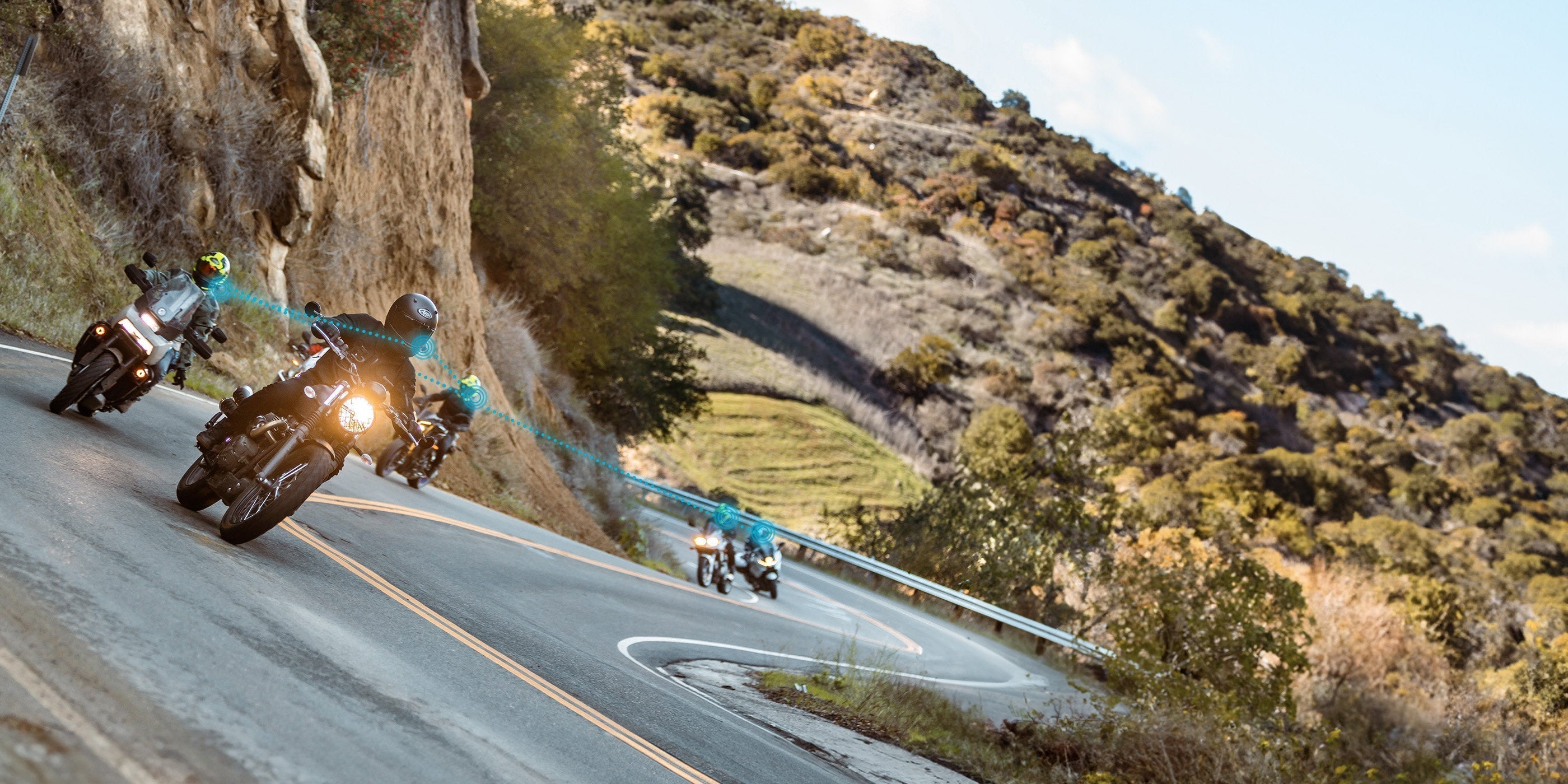
Group size is the first filter to apply when choosing an intercom. Bluetooth-only intercoms cap out at 2 to 4 riders in a daisy-chain configuration. If your group is larger than 4, you need a mesh-based system. Cardo's 2nd Generation Dynamic Mesh Communication supports groups of up to 31 riders on a single network, which covers most motorcycle clubs, touring groups, and track day participants. For groups above 15, a mix of sub-groups or different hardware will be needed.
Mesh vs Bluetooth: Which Technology Works Better in a Group?
Standard Bluetooth intercom creates a chain: Rider A connects to Rider B, B to C, C to D. If Rider B drops out of range, every rider behind them loses the connection. This is a real-world problem on group rides where the group spreads out, or riders take different lines.
Mesh communication creates a network where every device is a node. If one rider drops out of range, the network routes the signal around them automatically. No one loses contact, and riders can join or leave the group without anyone having to re-pair their device. Cardo's 2nd Generation DMC is the mesh standard used across the PACKTALK range.
Using Open Mesh vs Private Group Mesh
Cardo's 2nd Generation DMC supports two modes: Open Mesh and Private Group. Open Mesh connects any Cardo DMC unit in range, regardless of pre-pairing. This is useful for rallies, track days, or situations where riders join spontaneously. Private Group creates a closed network for a specific group of riders, which is better for club rides or touring, where you want a dedicated channel. Both modes use the same self-healing mesh infrastructure.
Communication Range: Unit-to-Unit vs Group Range
Cardo's 2nd Generation DMC units reach up to 1.6km (1 mile) between any two units in direct range. Across the full group, the network relays signal through each rider, extending the effective group range to up to 8km (5 miles). This means a touring group spread across several kilometres of road stays connected even if no two adjacent riders are within direct unit-to-unit range.
Auto-Reconnect and Self-Healing Networks
A self-healing mesh network automatically reconnects riders who drop out of range and come back into range, without any manual action. On a group ride, this means a rider who stops for fuel, takes a wrong turn, or gets caught at traffic lights reconnects to the group automatically when they return to range. Cardo's 2nd Generation DMC includes this as standard on all PACKTALK models.
Sound Quality at Speed
Group communication is pointless if you cannot hear the person speaking. Premium intercoms in the PACKTALK range use JBL speakers calibrated for helmet acoustics, which deliver clear audio even at motorway speeds. The PACKTALK PRO uses 45mm JBL speakers, and the PACKTALK EDGE uses 40mm JBL speakers. Both are significantly better than the standard speakers found in entry-level intercoms.
Battery Life on Long Group Rides
The PACKTALK PRO, PACKTALK EDGE, PACKTALK NEO, and FREECOM 4X all carry a 13-hour battery. All support fast charging: 20 minutes of charging delivers approximately 2 hours of use. The PACKTALK PRO and PACKTALK EDGE also support charge-while-riding via USB, making them suitable for all-day touring with a group.
Waterproofing and Durability
All PACKTALK units are rated IP67, meaning they are fully protected against dust and can withstand sustained rain and road spray without damage. For group rides in variable weather, IP67 is the standard to insist on. Entry-level intercoms with lower IP ratings may fail in sustained rain, which would break the group connection at the worst possible time.

Cross-Brand Compatibility
Most major intercom brands support standard Bluetooth pairing, which allows one-to-one communication between different brands. However, full mesh networking requires all riders to be on the same brand's mesh protocol. A Cardo user can pair with another brand via Bluetooth, but both will drop out of the mesh and communicate via a simple point-to-point Bluetooth link rather than the full group mesh. For large groups, it is worth coordinating on a single brand before everyone buys.
Best Cardo Intercoms for Group Riding
Cardo PACKTALK PRO: Best for Safety-Focused Group Riders
Best for: group riders who prioritise safety, long-distance touring, and maximum audio quality.
The PACKTALK PRO is Cardo's flagship unit and the strongest all-round choice for group riding. It runs 2nd Generation DMC for groups of up to 31 riders with an 8km group range, and adds Crash Detection with emergency alert as a meaningful safety feature for groups who ride in remote or challenging terrain.
The 45mm JBL speakers deliver the best audio in the Cardo range. It pairs with the Cardo Connect app and the Riser navigation app for a complete touring ecosystem. At $499.95 for a single unit, it is the premium option in the range.

Cardo PACKTALK EDGE: Best for Large Group Rides
Best for: large groups, riders who want premium audio without crash detection, club and touring use.
The PACKTALK EDGE delivers the same 2nd Generation DMC mesh performance as the PACKTALK PRO at $439.95. It supports 31 riders, 8km group range, and self-healing mesh. The 40mm JBL speakers are excellent for group communication at speed. The PACKTALK EDGE also supports Edgephones, a helmet-integrated headphone format compatible with select helmets.
For groups that do not need Crash Detection, the PACKTALK EDGE offers the same core group riding performance as the PACKTALK PRO at a lower price.

Cardo PACKTALK NEO: Best Mid-Range Group Intercom
Best for: groups of up to 15 who want DMC mesh without the premium price of the EDGE or PRO.
The PACKTALK NEO brings 2nd Generation DMC mesh to a mid-range price point. It supports 15-rider groups with the same self-healing mesh and 8km group range as the PACKTALK PRO and PACKTALK EDGE. The speakers are standard 40mm rather than JBL, which is a step down in audio quality but still performs well for intercom use. The PACKTALK NEO is the most accessible entry into Cardo's mesh ecosystem for groups on a tighter budget.

Cardo FREECOM 4X: Best for Small Groups Up to 4 Riders
Best for: small groups, couples, two-up riders, and budget-conscious buyers.
The FREECOM 4X uses Bluetooth intercom rather than DMC, which means it caps at 4 riders in a chain configuration. For small groups, this is perfectly adequate. It includes JBL speakers, a 13-hour battery, and IP67 waterproofing. The FREECOM 4X is the right choice for riding pairs or small groups of friends who want reliable communication without the cost of a mesh system.

Check the full model comparison page for more details.
Can Cardo and Sena Units Communicate in a Mixed Group?
Yes, via standard Bluetooth pairing for basic one-to-one intercom. Both support cross-brand Bluetooth connectivity. However, native mesh features only work within their own brand's ecosystem. A mixed group will communicate via Bluetooth chain rather than full mesh, which means the group size, self-healing, and range benefits of mesh do not apply. For large groups in particular, this is a strong reason to coordinate on a single brand before buying.
Communicating Hazards in Real Time
Crash Detection on the PACKTALK PRO
The PACKTALK PRO includes Crash Detection that monitors for impacts using the unit's onboard sensors. When a significant impact is detected, the system triggers an emergency alert via the Cardo Connect app and sends the rider's GPS location to a designated contact. For group rides in remote areas, this adds a layer of safety that goes beyond communication: if a rider at the back of the group comes off, the rest of the group and a designated contact are alerted automatically.
Staying Connected When the Group Spreads Out
On longer rides, groups naturally spread across several kilometres of road. Cardo's 2nd Generation DMC maintains group connectivity across up to 8km by relaying signal through each rider in the network. If two riders at opposite ends of a long group are beyond direct unit-to-unit range, the network routes the signal through the riders in between. The group stays connected as a single mesh as long as there are no gaps larger than the 1.6km unit-to-unit range.
Buying the Right Intercom for Your Group
Does Everyone Need the Same Brand?
For full mesh group communication, yes. Cardo's 2nd Generation DMC and other brands' mesh protocols are not cross-compatible for mesh networking. Riders on different brands connect via Bluetooth, which limits the group to a chain rather than a network and removes the self-healing and extended range benefits of mesh. If you are buying for a club or established group, it is worth agreeing on Cardo as a standard to get the full benefit of the DMC mesh ecosystem.
Single Units vs Duo Packs
Cardo offers Duo Packs for the PACKTALK EDGE and other models, which bundle two units at a reduced cost per unit compared to buying separately. For couples, riding partners, or pairs within a larger group, Duo Packs are the most cost-effective way to equip two riders. For larger groups, individual units with coordinated purchasing are the standard approach.
Best Motorcycle Intercom for Group Riding - FAQs
How many riders can connect on a Cardo intercom?
Cardo's 2nd Generation DMC intercoms (PACKTALK PRO, PACKTALK EDGE, PACKTALK NEO) connect up to 31 riders simultaneously on a single mesh network. The FREECOM 4X uses Bluetooth intercom and connects up to 4 riders in a chain. For groups larger than 15, multiple DMC sub-networks can be used, though not all riders will share a single channel.
What is Dynamic Mesh Communication (DMC)?
Dynamic Mesh Communication is Cardo's proprietary mesh networking protocol for helmet intercoms. It allows groups of up to 31 riders to communicate simultaneously without manual pairing chains, with a self-healing network that routes around any rider who drops out of range. Riders can join and leave the group at any time without interrupting communication for the rest of the group.
Can Cardo intercoms connect to Sena units in a group?
Yes, via standard Bluetooth pairing. Both brands support cross-brand Bluetooth connectivity. However, the native mesh features (Cardo DMC and Sena Mesh) only work within their own brand's ecosystem, so mixed groups connect via Bluetooth rather than full mesh.
What is the range of a motorcycle intercom in a group?
Cardo's 2nd Generation DMC units reach up to 1.6km (1 mile) unit-to-unit, and up to 8km (5 miles) across the full group as the network relays signal through each rider. Real-world range varies based on terrain, obstacles, and elevation.
Do I need the same brand intercom as the rest of my group?
Not necessarily. Most major brands, including Cardo support cross-brand Bluetooth connectivity. However, full mesh networking requires all riders to be on the same brand's mesh protocol. Groups with mixed brands communicate via Bluetooth rather than mesh.
Which Cardo intercom has the longest battery life?
The PACKTALK PRO, PACKTALK EDGE, PACKTALK NEO, and FREECOM 4X all carry a 13-hour battery. All support fast charging: 20 minutes of charging delivers approximately 2 hours of use. The PACKTALK PRO and PACKTALK EDGE also support charge-while-riding for full-day touring groups.
Can I listen to music and talk to my group at the same time?
Yes. Cardo units manage intercom and music simultaneously, with intercom taking priority. Riders can hear music continue between conversations, and GPS navigation plays through the same speaker without interrupting communication.
What is the best intercom for a motorcycle club with 10 or more riders?
The Cardo PACKTALK EDGE or PACKTALK PRO are the best options for clubs of 10 or more. Both support 31 riders on a single 2nd Generation DMC network with a group range of 8km, self-healing reconnection, and cross-brand Bluetooth for members still on older or different units.