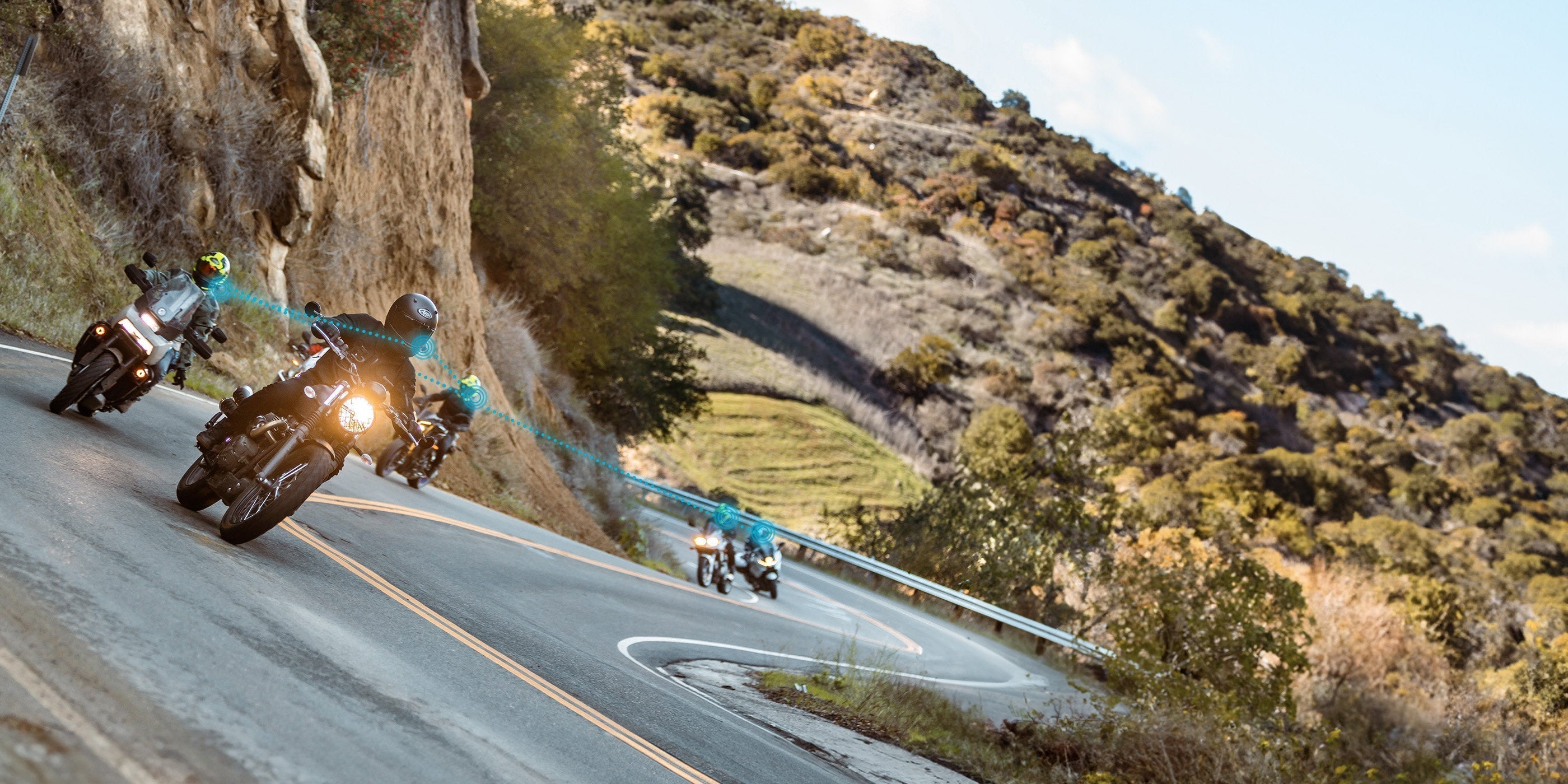





Dynamic Mesh Communication is a self-healing wireless networking technology that links every rider in a group into a single intercom network, where each unit acts as both a receiver and a relay. If one rider moves out of direct range, the network reroutes the signal through other riders automatically.
If a rider drops off the network entirely, the remaining group stays connected, and the dropped rider rejoins automatically when back in range. Cardo's 2nd Generation DMC links up to 31 riders, extends up to 1.6km between any two units, and up to 8km across the full group.
That is the short version. The rest of this guide covers why mesh outperforms standard Bluetooth for group rides, how Cardo's 2nd Generation DMC differs from the first generation, and which PACKTALK units use it.
If you want a deeper side-by-side breakdown, see the full Dynamic Mesh Communication explained guide.
How Standard Bluetooth Intercom Works
Standard Bluetooth intercom connects riders in a chain. Each unit pairs to the unit on either side of it, and the signal hops down the line from rider one to rider two to rider three, and so on. The protocol works fine for a pair or a small group of three, since the chain is short and stable. The problem starts when the group grows or when riders move out of position.
The Bluetooth Chain Problem
A Bluetooth chain has two structural weaknesses. The first is that the chain breaks at the weakest link: if rider three drops out of range, riders four, five, and six lose the rider one signal entirely, even if they are within range of each other. The second is range degradation. Each hop in the chain adds latency and reduces signal quality, so by the time a transmission reaches the fifth or sixth rider in a Bluetooth group, the audio is noticeably worse than between adjacent riders.
Reconnecting after a drop is manual. The lost rider has to repair their unit to the chain, often by pulling over and pressing buttons. In a real group ride, that turns a quick fuel stop into a five-minute reconnection exercise.
What Is Dynamic Mesh Communication?
Dynamic Mesh Communication solves both Bluetooth chain problems by abandoning the chain entirely. Instead of a fixed link from rider one to rider two to rider three, every unit in the network connects to every other unit it can reach, and the network constantly recalculates the best path for each transmission. The result is a flexible, self-organising network where any rider can be the relay, and no single rider is a single point of failure.
How the Mesh Network Finds Its Own Route
Each Cardo unit in a DMC group acts as both a receiver and a relay. When rider one speaks, the unit broadcasts the audio, and every unit within direct range picks it up. Those units then re-broadcast the signal to units within their range, which extends the effective reach of the original transmission through the network. The mesh constantly checks which routes are available and which give the cleanest signal, and switches between them as riders move.
None of this requires rider input. Pairing a group of 10 takes only a few seconds at the start of the day; after that, the network manages itself.
Self-Healing: What Happens When a Rider Drops Out
When a rider drops out of range, the mesh recognises the change and reroutes the signal through other riders that are still in the network. The remaining group stays fully connected. When the dropped rider comes back within range of any other rider in the network, they rejoin the mesh automatically, with no button presses, no app interaction, and no pairing process. This is what "self-healing" means in practical terms: the network repairs itself faster than a rider can notice the gap.
Cardo 2nd Generation DMC: Second-Generation Mesh
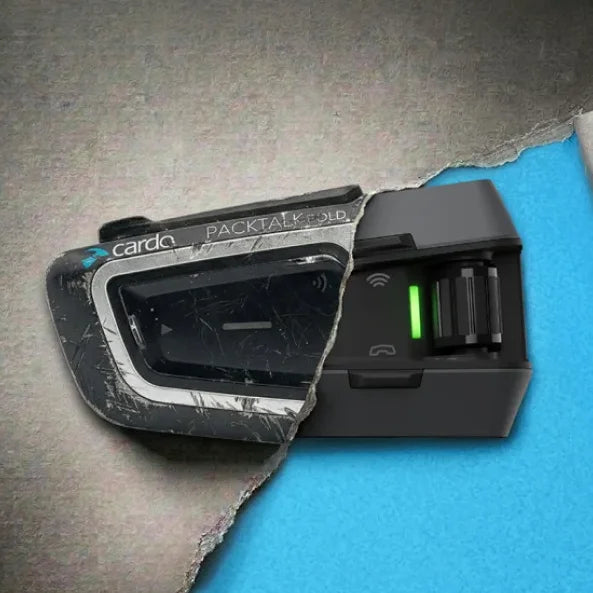
2nd Generation DMC is the second generation of Cardo's mesh protocol. It builds on the original DMC with faster pairing, wider compatibility, improved range, and wideband audio for clearer intercom quality. Every current PACKTALK unit runs 2nd Generation DMC, which means any mix of current-generation PACKTALK units (PRO, EDGE, NEO) can join the same mesh group without compatibility issues.
Group Size: Up to 31 riders
Cardo 2nd Generation DMC supports up to 31 riders on a single mesh network. That covers everything from a small touring crew to a full club ride. For groups larger than 31, riders can be split into multiple mesh groups, but most riders never need to. The 31-rider capacity is the same on the PACKTALK PRO, PACKTALK EDGE, and PACKTALK NEO.
Range: Unit-to-Unit and Group Range Explained
Two range numbers matter on a mesh network: unit-to-unit range and group range. Unit-to-unit range is the maximum distance between any two units that can talk directly without a relay. On Cardo 2nd Generation DMC, that is up to 1.6km / 1 mile. Group range is the maximum effective distance across the full network as the signal is relayed through each rider in the chain. On 2nd Generation DMC, the group range is up to 8km / 5 miles.
Real-world range varies based on terrain, line of sight, and obstacles. Open motorway with riders in formation will get close to the rated maximum. Twisty roads through forest, mountain passes, or urban environments will deliver less.
For riders shortlisting Cardo units specifically for group riding, the best motorcycle intercom for group riding guide covers the practical buying decision in detail.
Open Mesh vs Private Group Mesh
Cardo 2nd Generation DMC supports two mesh modes. Choosing between them depends on whether you want a closed group of known riders or an open network anyone with a Cardo DMC unit can join.
Private Group Mesh
Private Group Mesh is a closed group. Riders are added to the group once during initial setup, and after that they reconnect automatically whenever they are in range of each other. Private Group is the right choice for a regular riding crew, a club, or any group that wants control over who can join.
Open Mesh
Open Mesh is a public channel. Any Cardo DMC unit on the same Open Mesh channel can join without pre-pairing, which makes it useful for ad-hoc group rides, charity events, or meeting riders on the road. Open Mesh is set up through the Cardo Connect App.
Both modes are configured through the Cardo Connect App, which also manages firmware updates and unit preferences.
Audio Quality on a DMC Connection
Mesh quality matters as much as range. 2nd Generation DMC uses a wideband audio codec that delivers significantly clearer voice than the narrowband codecs used by standard Bluetooth intercoms. The practical result is that voices over DMC sound natural rather than compressed, even at the edge of the range. Wind noise suppression is built into the unit's audio processing, so transmissions stay intelligible at motorway speeds.
Because DMC runs unit-to-unit without going through cellular or Bluetooth chain compression, the audio path is shorter and cleaner than a Bluetooth chain. The Sound by JBL speakers fitted to current PACKTALK units deliver the audio with enough range to handle music, GPS prompts, and intercom simultaneously without the audio mixing turning into a mess.
Which Cardo Intercoms Use Dynamic Mesh Communication?
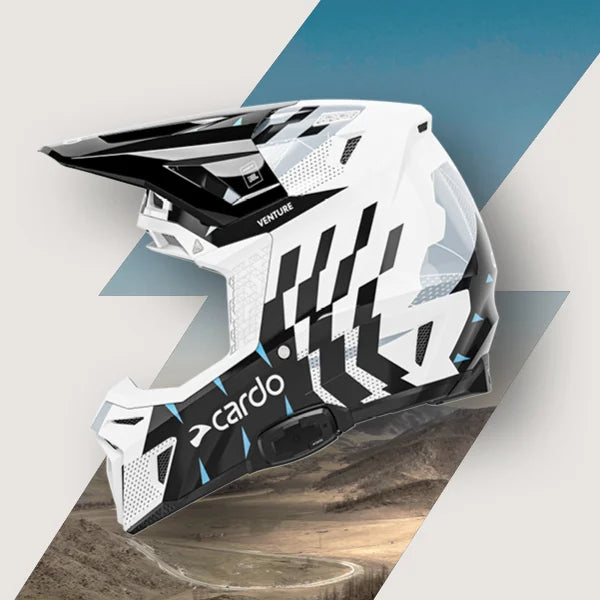
Three current Cardo motorcycle units run 2nd Generation DMC: the PACKTALK PRO, PACKTALK EDGE, and PACKTALK NEO. All three share the same mesh capability, group capacity, and range. The differences between them sit in audio, mount, battery features, and a few premium extras.
PACKTALK PRO
The PACKTALK PRO is Cardo's flagship motorcycle unit. It runs 2nd Generation DMC with the full 31-rider capacity and the full 1.6km unit-to-unit / 8km group range. On top of DMC, the PACKTALK PRO adds Crash Detection (a three-part system using unit sensors, the Cardo Connect App, and Cardo's cloud to detect impacts and send an automated emergency alert with GPS location to a designated contact, available in selected regions), 45mm JBL speakers, Auto On/Off via an IMU-powered proximity sensor, and a 3-year warranty.
PACKTALK EDGE
The PACKTALK EDGE delivers the same 2nd Generation DMC experience as the PACKTALK PRO: 31 riders, 1.6km unit-to-unit, 8km group range, self-healing reconnection, Open Mesh, and Private Group. It uses 40mm JBL speakers (vs 45mm on the PACKTALK PRO), keeps the Air Mount, supports charge-while-riding, and carries the same 3-year warranty. If you are buying primarily for group communication, the PACKTALK EDGE gives you the full DMC experience at $60 less than the PACKTALK PRO.
PACKTALK NEO
The PACKTALK NEO is the value entry into the mesh range. It runs the same 2nd Generation DMC, the same 31-rider capacity, the same 1.6km unit-to-unit range, and the same 40mm JBL speakers as the PACKTALK EDGE. The trade-offs sit elsewhere: the PACKTALK NEO uses a clickable mount rather than the Air Mount, does not support charge-while-riding, and carries a 2-year warranty rather than 3. For group communication on a budget, the PACKTALK NEO gives you the full mesh experience.
DMC vs Bluetooth: A Practical Comparison
The fastest way to see why mesh matters is to compare the two technologies on the things that actually affect a group ride.
|
Feature |
Cardo 2nd Generation DMC |
Standard Bluetooth Intercom |
|---|---|---|
|
Network type |
Self-healing mesh |
Linear chain |
|
Max group size |
Up to 31 riders |
Typically 2 to 4 riders |
|
Unit-to-unit range |
Up to 1.6km / 1 mile |
Shorter, varies by model |
|
Group range |
Up to 8km / 5 miles across network |
Limited to chain length |
|
Reconnect after drop |
Automatic |
Manual, often requires re-pairing |
|
Audio quality at distance |
Consistent across network |
Degrades with each chain hop |
|
Single point of failure |
No |
Yes, weakest link breaks the chain |
|
Pairing time for a group of 10 |
A few seconds |
Several minutes |
|
Example Cardo unit |
PACKTALK PRO, EDGE, NEO |
FREECOM 4X (up to 4 riders) |
If you want to see specs side by side across the full range, the product comparison tool covers every current Cardo unit. The FREECOM 4X uses standard Bluetooth rather than DMC, with a maximum group size of 4 riders. For small groups riding close together, it is enough. For anything larger or more spread out, a DMC unit is the right choice.
Choosing a Cardo DMC Unit
Browse the full range of Cardo motorcycle intercoms, or read the how to choose a motorcycle intercom guide if you are still narrowing down options between the PACKTALK PRO, EDGE, and NEO.
Dynamic Mesh Communication - FAQs
What is Dynamic Mesh Communication?
Dynamic Mesh Communication is a wireless networking technology that links every rider in a group into a self-healing intercom network, where each unit acts as both a receiver and a relay. If one rider drops out of range, the network reroutes the signal through other riders automatically. Cardo's 2nd Generation DMC supports up to 31 riders with a unit-to-unit range of up to 1.6km and a group range of up to 8km.
How is DMC different from Bluetooth intercom?
Standard Bluetooth intercom links riders in a chain, where each unit pairs to the unit on either side of it and the signal hops down the line. If one rider drops, the chain breaks for everyone behind them. DMC links every unit into a self-healing mesh where any rider can be the relay, the group stays connected when individuals drop, and a separated rider rejoins automatically when back in range.
How many riders can connect on Cardo DMC?
Cardo 2nd Generation DMC supports up to 31 riders on a single mesh network. The 31-rider capacity is identical on the PACKTALK PRO, PACKTALK EDGE, and PACKTALK NEO. For groups larger than 31, riders can split into multiple mesh groups.
What is the range of Cardo 2nd Generation DMC?
Unit-to-unit range on Cardo 2nd Generation DMC is up to 1.6km / 1 mile between any two units, and group range is up to 8km / 5 miles across the full network as the signal relays through each rider. Real-world range varies based on terrain, line of sight, and obstacles.
Does DMC reconnect automatically when a rider rejoins?
Yes. When a rider drops out of range, the mesh reroutes around them automatically and keeps the rest of the group connected. When the dropped rider returns within range of any other rider in the network, they rejoin the mesh automatically with no rider input. This is the self-healing behaviour that defines mesh networking.
Can Cardo DMC connect with Sena intercoms?
Cardo and Sena units can connect to each other via standard Bluetooth pairing, but native mesh networking does not work across brands. Cardo DMC only meshes with other Cardo DMC units. Cross-brand Bluetooth pairing limits the mixed group to a Bluetooth chain, with no self-healing and lower group capacity.
What is the difference between Open Mesh and Private Group Mesh?
Open Mesh is a public channel that any Cardo DMC unit on the same channel can join without pre-pairing. Private Group Mesh is a closed group set up once during initial pairing, where only invited riders can join. Open Mesh suits ad-hoc rides and events; Private Group suits regular crews and clubs that want control over who is on the network.
Does the FREECOM 4X have Dynamic Mesh Communication?
No. The FREECOM 4X uses standard Bluetooth intercom rather than DMC, with a maximum group size of 4 riders. For small groups riding close together, the FREECOM 4X is enough. For groups of more than 4 riders or any group that spreads out on the road, a PACKTALK DMC unit is the right choice.